
Designing a Home that Grows With Your Life


The complete guide to spaces that work for the way your family actually lives - from high-energy mornings and casual Friday nights to the holiday gatherings that fill every room.
IN THIS GUIDE
Summer has a way of revealing what our homes are actually built for. The backyard fills up, friends arrive, and suddenly we're rearranging chairs so everyone can fit - or, watching guests drift toward the kitchen because the living room just doesn't quite pull people in.
If that sounds familiar, the problem isn't your hosting. It's your layout.
Most living rooms are designed to photograph well for a real estate listing, not to support the way real families actually live. This guide was written for homeowners who love hosting but feel like their space is working against them. The goal isn't to turn your home into a venue: it's to make the space you already have work beautifully for the life you want to live in it.
i. Why Most Living Rooms Don't Support Entertaining
A common design mistake we see is arranging a room entirely around the television. When everything points at the screen, it's a perfect setup for movie nights, but the wrong configuration for a dinner party, game night, or a gathering where people actually want to talk.
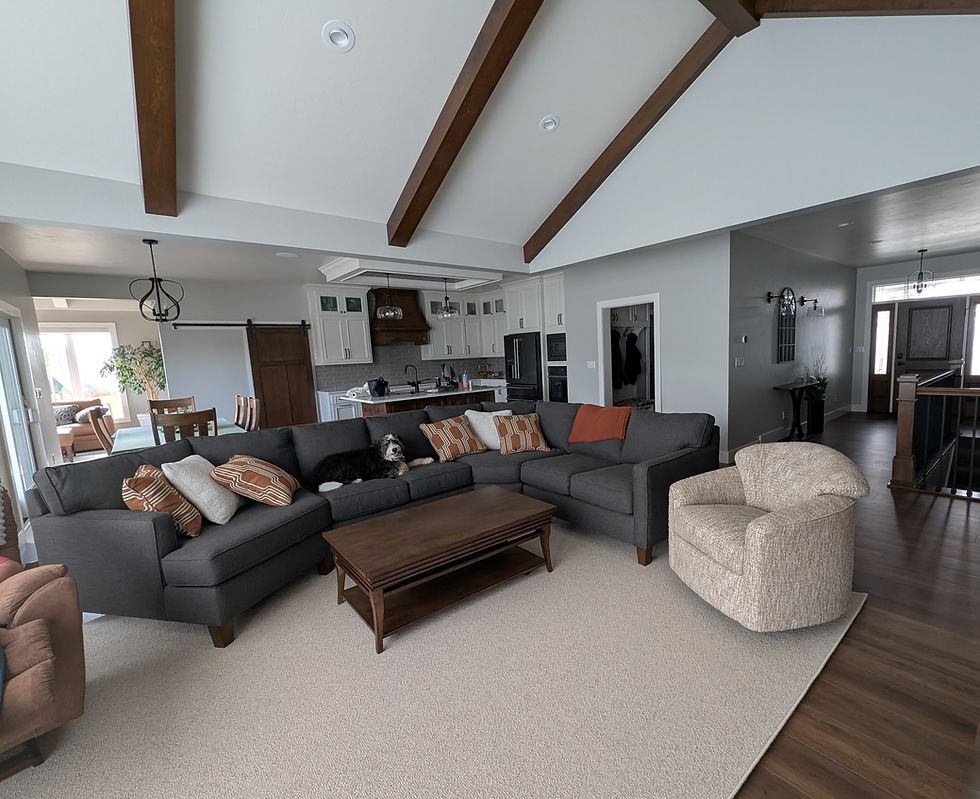
The second trap is furniture that's too large for the room. An oversized sectional might look inviting in a showroom, but if it blocks the natural traffic flow between your living room and kitchen, it makes gatherings feel restricted. Entertaining requires a layout that breathes - one that allows guests to move easily from a conversation group out to the patio or around to the dining table.
Signs your layout is working against you:
You rearrange furniture every time people come over
The living room feels isolated, causing guests to gather in the kitchen instead
There are bottlenecks between the living room, dining area and kitchen during gatherings
The only place for a real conversation is squeezed onto one sofa
You have a lingering feeling that the space could look or function much better, but you aren't sure how to fix it
These aren't personal failures — they're design problems, and they have design solutions. The good news is that a room doesn't need to be large to work well for entertaining. It needs to be intentional.
ii. Seating Arrangements That Encourage Conversation
The fundamental rule of conversational comfort: people connect naturally when they're within about eight feet of each other. Push seating beyond that and guests either raise their voices or stop talking altogether.
The Conversational ClusterBEST FOR: GAME NIGHTS, DINNER PARTIES |
Two sofas facing each other with a coffee table between them, or a sofa paired with two chairs angled inward. This is the classic arrangement for a reason — it creates an enclosed space where conversation happens without effort. The enclosed geometry means no one is left on the outside looking in. |
The Flexible AnchorBEST FOR: MIXED-SIZE GATHERINGS |
A main sofa and chairs that can be pulled away from the walls, with a pair of lightweight occasional chairs or ottomans that can be moved as needed. This lets you expand the seating radius for a larger crowd without permanently committing to a large footprint. The key is choosing the occasional pieces carefully: they need to be light enough to move easily but substantial enough to feel intentional, not afterthought. |
The Split ZoneBEST FOR: HOLIDAY DINNERS, LARGER ROOMS |
For larger rooms, consider two defined areas: one for intimate conversation, one with more casual, open seating. If you host dinners that spill from the dining room into the living room, having a clearly defined secondary zone means overflow guests don't feel exiled - they feel like they're in a better seat. |
A room arranged for conversation first can always accommodate a movie night. A room arranged for the television almost never accommodates a dinner party.
iii. Flexible Furniture for Different Gathering Sizes
The most practical thing you can add to an entertaining-ready living room is flexibility. That doesn't mean everything has to be modular or fold-up. It means choosing pieces that serve more than one purpose - pieces that earn their space every day, not just twice a year.
EVERYDAY + ENTERTAINING
The Flat-Top Ottoman
Functions as a footrest on quiet evenings, becomes extra seating or surface space when guests arrive. The key is choosing one with a firm, flat top, not a soft cushioned dome that's uncomfortable to sit on.
ADAPTABLE SURFACE
Nesting Tables
Separated and spread around the room when everyone has a drink in hand; tucked away neatly when it's just Tuesday. They solve the problem of guests holding glasses all evening because there's nowhere to set them down.
HIDDEN CAPACITY
The Sofa Bench
A bench at the end of a sofa, or pulled in front of a coffee table, quietly seats one or two more people without committing to another full chair. It also disappears into the room composition when not in use.
What doesn't work is storing extra furniture that only gets used twice a year. Scale your everyday arrangement for how you actually live, then plan specifically for how you expand it when you need to.
iv. Balancing Everyday Comfort with Party-Ready Style
This is where people can get stuck. They want a living room that feels cozy and lived-in on a regular Thursday AND that can handle twelve people on a Saturday night in December. Those two things aren't as different as they seem, but they do require the right approach to materials and build quality.
Choose fabrics that actually cleanPerformance fabrics have come a long way. Today's best options are nearly indistinguishable from natural textiles at a glance and far more forgiving in practice. If you're choosing between a fabric that photographs beautifully and one that cleans easily, the one that cleans easily will make your life better for years longer. |
Cushions that hold their shapeCushions that collapse after an hour of use look immediately uninviting in a room full of people. High-density foam with a down-wrap finish gives you the softness that photographs and feels right, with the resilience that holds up through a long evening. It's a difference you notice within the first gathering. |
Surfaces that function without coastersA coffee table that requires coaster vigilance at every gathering becomes a source of low-grade anxiety. Stone, hardened glass, or properly finished hardwood surfaces let guests set their drinks down without a second thought, and lets you be a host instead of a furniture guardian. |
Lighting that shifts the moodThe single fastest change you can make to an entertaining-ready room is lighting control. A room that can go from bright and functional in the afternoon to warm and dim in the evening without changing a thing is a room that works for every occasion. Dimmers cost very little and change everything. |
v. Designing for Every Stage of Your Family's Life
One of the most common reasons homeowners put off investing in their living room is the sense that the timing isn't right - that they should wait until the kids are older, or until they're sure about what they want. This is the lifecycle myth, and it costs people years of living well in the home they already have.
The truth is that a room designed with durability and adaptability as its core values works at every stage. The investment isn't in furniture that suits a specific moment: it's in furniture that can carry you through all of them.
STAGE ONE
Young Families
Choose performance fabrics, rounded edges, and washable rugs. The goal is a room that can handle real life without becoming a room you're afraid to use. Durability is key at this stage.
STAGE TWO
Active Households
Choose flexible arrangements, ottomans, and multi-function pieces that can shift from homework zone to movie night to impromptu hosting. The room needs to be genuinely adaptable.
STAGE THREE
Sophisticated Entertaining
Conversation-first arrangements, refined materials, and pieces that reward attention are key now. The room that survived the previous stages now becomes the room you're proud to show people.
STAGE FOUR
Heritage and Legacy
Quality furniture becomes an heirloom. The sofa your family has lived in for twenty years tells a story. Premium materials are the only ones worth that journey.
The furniture decisions you make now will determine which of these stages you get to experience rooms that actually support you, OR in one that you're still waiting to fix. The families who invest in quality early almost universally say the same thing: they wish they had done it sooner.
vi. The Werner Harmsen Approach to Lifestyle-First Design
When you sit down with our design team, we're probably going to ask a question you aren't expecting: How do you actually use this room?
We don't start with paint swatches or fabric samples. We start with your Sunday dinners, your Friday game nights, and your quiet Tuesday mornings. We ask about the dog. We ask how many people you had over at the holidays and where they ended up. We ask what you love about the room and what drives you quietly crazy about it.
A room designed around the way you live is one that works every single day, not just when you've rearranged it for company. Our furniture lines are chosen specifically for families who want to live fully in their homes: pieces built to hold up, crafted to look better over time, and selected with the honest belief that you shouldn't have to choose between beauty and function.
If your living room feels like it's fighting your lifestyle instead of supporting it, that's a solvable problem. We've solved it for homeowners across the greater
Waupun area for decades, and we'd like to help you solve it, too.
WERNER HARMSEN DESIGN CONSULTATION
START WITH HOW YOU ACTUALLY LIVE
Our design team is ready for a conversation - because creating a space you love starts with understanding how you live.


Comments